


Using GlusterFS as a storage domain for Oracle Linux Virtualization Manager (OLVM) offers several advantages, particularly in terms of scalability, high availability, and cost-effectiveness. Here’s a breakdown of how it works and its benefits:
How it Works:
-
GlusterFS Setup: You’ll need to set up a GlusterFS cluster, which involves multiple servers (at least 2-3 for redundancy) acting as storage nodes. These servers will have disks dedicated to the GlusterFS volume.
-
Volume Creation: Within the GlusterFS cluster, you create a volume. This volume can be configured in different ways, such as:
- Distributed: Files are spread across all nodes for performance.
- Replicated: Files are copied across multiple nodes for redundancy.
- Distributed-Replicated: Combines both for performance and redundancy.
-
Storage Domain in OLVM: In the OLVM Administration Portal, you create a new storage domain and specify the GlusterFS volume as the storage location. OLVM will then use this GlusterFS volume to store VM images, ISO files, and snapshots.
Benefits of using GlusterFS with OLVM:
- Scalability: GlusterFS allows you to easily expand your storage capacity by adding more nodes to the cluster. This is crucial for growing virtual environments.
- High Availability: With replicated volumes, if one GlusterFS node fails, the data is still available on other nodes, ensuring continuous operation of your VMs.
- Cost-Effectiveness: GlusterFS is open-source software, so you can avoid licensing fees associated with proprietary storage solutions.
- Flexibility: GlusterFS supports various volume types, allowing you to choose the best configuration for your needs in terms of performance and redundancy.
- Simplified Management: Integrating GlusterFS with OLVM simplifies storage management as you can manage both your virtual machines and storage from a single interface.
Key Considerations:
- Network Performance: GlusterFS relies on the network for communication between nodes. A high-performance network (10Gbps or faster) is recommended, especially for large-scale deployments.
- Storage Design: Plan your GlusterFS volume configuration carefully, considering factors like capacity, performance requirements, and redundancy needs.
- Monitoring and Maintenance: Implement proper monitoring of your GlusterFS cluster to ensure its health and performance. Regular maintenance tasks, such as checking for disk errors and updating software, are also essential.
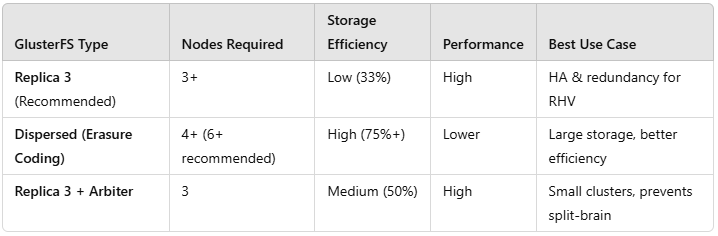
Which GlusterFS Type to Choose for OLVM ?
In summary, using GlusterFS as a storage domain for OLVM offers a flexible, scalable, and cost-effective way to manage storage for your virtualized environment. By combining the strengths of both technologies, you can create a robust and efficient infrastructure for your virtual machines.